Wednesday, December 16, 2009

GLOBAL RECESSION


Global recession is said to represent a period of economic slowdown at an economic growth of 3% or less. The Great Depression was a severe worldwide economic depression in the decade preceding World War II. The timing of the Great Depression varied across nations, but in most countries it started in about 1929 and lasted until the late 1930s or early 1940s. The depression originated in the United States, starting with the stock market crash of October 29, 1929 (known as Black Tuesday), but quickly spread to almost every country in the world. Followed by consumers, many of whom had suffered severe losses in the stock market the previous year, cut back their expenditures by ten percent, and a severe drought ravaged the agricultural heartland of the USA beginning in the summer of 1930.
The global recession of 2007-2009 has been said to be the next worst thing to strike the world after the Great Depression. However, seeing the current scenario, it seems that things aren't going to turn worse. Most countries as U.S. have recorded a 'U' shaped recovery curve with a recovery:loss ratio of almost 1. Some unlucky nations as U.K. & Japan have had an 'L' shaped recovery curve, while riding high n stringent regulations, timely curbing of credit & inflation & a conservative economy, China & Brazil & some other Latin American countries have recorded a V shaped recovery curve. Even India can said to experience a 'V' recovery. 
With regards to what went wrong, a lot of explanations have been given; the origin being undisputed, America. The Chairman of Fed Reserve, Alan Greenspan has been accused of being instrumental to deregulating the financial system in America, post the dot-com bubble burst & lowering the interest rate barriers. The leniency caused rise of a credit driven market which spurted a false economic boom. Alas, as some have observes, Greenspan just delayed the outcome of the dot com bubble burst. Yet another group of analyst point their  finger at The Clinton Government who had reportedly put the Freddie & Fannie institutions under considerable pressure to loosen their policies. Fannie Mae, America's largest underwriting institution for mortgage loans was asked to extend credits to low & medium income families, thus, leading to a gradual slip of the situation beyond control to lead to what we know today as sub prime crises. The rising inflation of commodity prices, post a stagnation in 1999-2001, shook consumer sentiments considerable. The highlight point being Oil prices rise to above $150 a barrel. America riding on high debt with their sub prime mortgages traded across the world & over dependence of some countries on exports to the leading nation of the world saw major countries across the world catch a cold as America sneezed.
The savings rate in India is around 35% and the demand is consumer driven not state driven unlike China. RBI rules are strict and banks have shown great amount of prudence, The banks are not state controlled, on the contrary they do not always heed RBI’s recommendations. I am certain that with political stability, reforms will come in steps & not in one large step – prudence is the answer. However, problems  from the short-term issue of droughts to the longer-term issue of dependence on foreign oil and fiscal deficits to the omnipresent political inefficiencies

Wordz & Jargonz- III


Sanguine: Of the color of blood; red; Cheerfully confident; optimistic. However, sanguinary means 'blood-thirsty'


Market capitalization/capitalisation (often market cap) is a measurement of the size of a business enterprise (corporation) equal to the share price times the number of shares outstanding of a public company. Capitalization could represent the public opinion of a company's net worth and is a determining factor in stock valuation
Traditionally, companies are divided into large-capmid-cap, and small-cap. Recently people have added 'micro-cap' and 'nano-cap'. People have rules of thumb to determine category from market capitalization. These need to be adjusted over time due to inflation, population change, and overall market valuation (for example, $1 billion was a large market cap in 1950 but it is not very large now), and they may be different for different countries. A rule of thumb may look like:


  • Large-cap: $10 billion–$200 billion
  • Mid-cap: $2 billion–$10 billion
  • Small-cap: $300 million–$2 billion
  • Micro-cap: $50 million-$300 million[4]
  • Nano-cap: Below $50 million
Different numbers are used by different indexes; there is no official definition of or general agreement about the exact cutoffs.

Tuesday, December 15, 2009

Wordz & Jargonz- II


Aficionado
Pronounced as affi- shio- nado, the word means a zealous proponent, say a sports aficionado.

Brand Equity


The brand equity refers to an intangible aspect that depends on basically three perspectives:
Financial : A method of evaluating the brand equity is determining the premium price which a brand has for a generic product
Brand extensions: A successful brand can be used for launching additional brands related to that one
Consumer: A powerful brand encourages the positive attitude of the consumer over the product


Brand Value
This can be defined as one of the parameters which contribute to brand equity giving it a more tangible or trade able perspective. 
Brand-Price-Trade-Off (BPTO) premium – Many brands are shown and the consumer chooses one of them. Afterwards the prices are modified and the consumer makes a new choice. the purpose of this method is to obtain a relative value of the brand. For example, Coca-Cola scored 5% more than Pepsi.
Brand vs. Functional value one- A brand has a functional element and an emotional or associative one identifying the functional value. Often the “conjoint analysis” method is used for this. For determining the emotional value we can use the studies related with the brand association or the sensory emotional studies
Researched value vs. Accountant’s value – another way refers to the added financial brand value in comparison with similar products. A way to measure it is EVA (economic value added).The researcher's value refers to brands' perception as can be ascertained through market research.

Monday, December 14, 2009

Climate Conference at Copenhagen- 2009


In 2012 the Kyoto Protocol to prevent climate changes and global warming runs out. To keep the process on the line there is an urgent need for a new climate protocol & between 6th - 18th December 2009, leaders from 170 countries would meet together in this Danish city for the last time before The Copenhagen Protocol would be formulated. The main theme of the meet is the amount by which each country would cut down on its carbon emission in a stipulated time & debates have been happening with regards to how high the bars should be for developed nations & or developing nations vis-a-vis, the technology & investment required. 
The US's stance has been clear to date that they are unwilling to join the Kyoto Protocol or Kyoto-like-protocol which will submit them to any legal bindings with regards to emission cuts. The sticky issues to date has been:
  • Technology transfer wherein the developed countries would have to ensure that all other countries would get access to technology that would lead to carbon free development & would have to invest a considerable amount in R&D in this regard
  • Patent issue of such technologies is a related issue
  • America's stand to not be legally bound by emission norms has proven a major challenge
  • The need to reduce the global temperature by 2% by 2020.
  • The need to progressively reduce the carbon foot prints without compromising on development
  • The need for legal clauses to be introduced to ensure commitment of countries in pursuing anti- emission norms & goals.
  • Australia, Japan & other developing nations are mooting for uniformity in rules for all developed nations
What is dreaded is countries pursuing their personal goals too zealously pushing aside the need for sustainable development. If the leaders of the Nations fail to come forth with an agreement, little developments can be seen in bringing climate control measures when not just the Copenhagen, but all such conferences could be but cul-de-sacs. 


Sunday, December 13, 2009

TELANGANA ISSUE: The 'Why It Should Not Happen' Aspect


The detractors to the formation of Telangana give the following reasons:
  • The Andhra people will take away all their investments from Telangana
  • Muslims will dominate if Telangana becomes a State
  • Hyderabad will become a Union Territory; away from both Andhra and Telangana
  • Andhra people are hardworking, enterprising and well-educated
  • We will lose our identity as Telugu people.
Bottom line: All these are mere excuses. In reality, a separate Telangana makes sense for one reason alone- that its people want it.
If we take into view the repercussion of the Telangana Issue announcement by Home Minister, Mr Chitambaram, maybe the Center could have delayed the announcement or maybe a massive announcement was made without enough ground work.
 As feared, selfish politicians as Ms Mayawati, the CM of U.P. has already started poisoning the minds of public to push the Government for a trifurcation (!!!) of U.P. into Poorvanchal (East U.P.), Pashchimanchal (West U.P.) and Bundelkhand. On the other hand we have the Gorkhas pressing the issue of carving out a Gorkhaland threatening to chop off West Bengal's crown which is responsible for connecting the North East states of India. Some fear that this would just lay the premises for the rise of an entirely new state comprising the 13 sisters of North- East India.   

TELANGANA ISSUE: The 'Why It Should Happen' Aspect


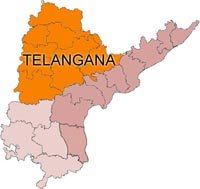
Telangana or Telingana is a region and proposed new state currently part of Andhra Pradesh in India.The region lies on the Deccan plateau to the west of theEastern Ghats range, and includes the north-western interior districts of WarangalAdilabadKhammam,MahabubnagarNalgondaRangareddyKarimnagarNizamabadMedak, and the state capital, Hyderabad. The Krishna and Godavari rivers flow through the region from west to east. On 9 December 2009, Indian Home Minister P. Chidambaram stated that the "process of separation of Telangana from Andhra Pradesh will be initiated soon". This statement was released on behalf of the Government of India.

Proponents in favor of the division have stated the following reasons to strengthen their claim: 

  • They believe that there should be many more states in India than what we have now. A country like US which has 1/3 population of India has 50 states, why should we have 28 states only.
  • The proposal for Vidharba (from Maharashtra) & Telengana were put forth along with the one for Uttaranchal (from Uttar Pradesh), Chattisgarh (from Madhya Pradesh), and Jharkand (from Bihar); but based on what parameters were the first two postponed indefinitely while the latter three were put to action.
  • India has the capacity and requirement to take on few more states, that would improve administration, reduce the influence of certain big states, allow interior and backward regions get attention and care from the center.                                        
Why a separate Telengana? Why aren't the people happy with the present administration?

~ Telangana is less developed compared to Andhra.
~ Rivers like Krishna and Godavari flow through Telangana, but the water from the dams are sent to Andhra.


~ Because of less literacy and backwardness of Telangana people, most of the new jobs, postings in government and education are given to people from Andhra.

~ Except for common language, the people of Andhra and Telangana have different dialects,histories, cultural systems, different food habits  

The Chronology of Telangana Struggle


  • In 1947, India got Independence- in 1948, Indian Army ousted Nizam of Hyderabad to include Hyderabad and its regions into India. 
  • In 1953, Andhra was formed (from Madras State) as a state under Reorganization of States based on linguistic lines. 
  • In 1956, Telangana was merged with Andhra though there was a demand for a separate state of Telangana. 
  • In 1956, there were protests in Hyderabad for Telangana which was quelled by police killing some of the protestors.Ther reasons for separate Telangana are plenty. 
  • In 1969, there was a major revolt in Telangana region by students, professors, government employees, politicians and many others demanding a separate state. The movement was quashed- many were jailed. What was left behind was a list of hollow promises.


Tuesday, December 8, 2009

BOOST UP YOUR GK !!!

  • The Essar group of Companies is promoted in India by which family group:
    • RUIAS
  • Marlboro is owned by:
    • PHILIP MORRIS
  • Amtrex air conditioner has a technical collaboration with:
    • HITACHI
  • People To Know:
    • VENU SRINIVASAN- Chairman & Managing Director, TVS Motors
    • VENUGOPAL DHOOT- Chairman, Videocon
  • To which group did Ambanis of Reliance group sell their holdings in L&T:
    • A.V. BIRLA GROUP
  • Which company owns the footwear brand Stryde
    • TATA
  • Blowpalst launched which brand of Suitcase in India:
    • DELSEY
  • Some Dates To Know:
    • International Women's Day - March 8
    • World Environment Day - June 5
    • World Literacy Day - September 8
    • World Tourism Day - September 27
    • World AIDS Day - December 1